



















































Generate your free Human Design chart—personal, relationship, or transit—and start exploring your design with guided insights.
Steve Jobs' Channels and Openness
Oct 19, 2026

Now lets take a look at the channels that gave Jobs the specific flavor of his energy and at the definition structure that shaped how he processed experience internally.
The Channel of Recognition (41-30) - Fully Unconcious (Design)
The Channel of Recognition, connecting Gate 30 in the Solar Plexus to Gate 41 in the Root, is part of the abstract sensing circuit. It's designed for feeling. The drive here is to explore life through the full range of human emotion, and the mechanism is imagination and fantasy. Someone carrying this channel spends time dreaming. They feel pulled toward new experiences, restless for the next one, driven by desire. The key is that the desire isn't really about getting what you expect. It's about the feeling itself: the capacity to fantasize, to be stirred, and to stir others in return.
In Jobs, this channel shows up as the famous reality distortion field. He could sit in a room and describe a product that didn't exist yet in terms so vivid that people felt it. He could make engineers believe they could do things they had considered impossible, because his imagination generated genuine feeling in them. That's the Channel of Recognition at work: the ability to project a fantasy with such emotional intensity that it becomes contagious.
His product launches were masterclasses in this. He wasn't presenting specifications. He was generating feeling. He was sharing the experience of what it would be like to hold the thing, to use it, to have your life changed by it. The audience at a Jobs keynote wasn't being informed. They were being moved emotionally. The restlessness in this channel also fits. Jobs was always looking for the next thing. Once a product shipped, his attention was already somewhere else. There was a constant pressure from the Root Center pushing upward into the Solar Plexus, a need to feel something new, to chase the next experience. This is the abstract process at its core: experience, then reflect, then share what was learned through the feelings generated. His entire career can be read as a series of experiential cycles. Try something. Feel it fully. Learn from it. Move on. Tell the story.
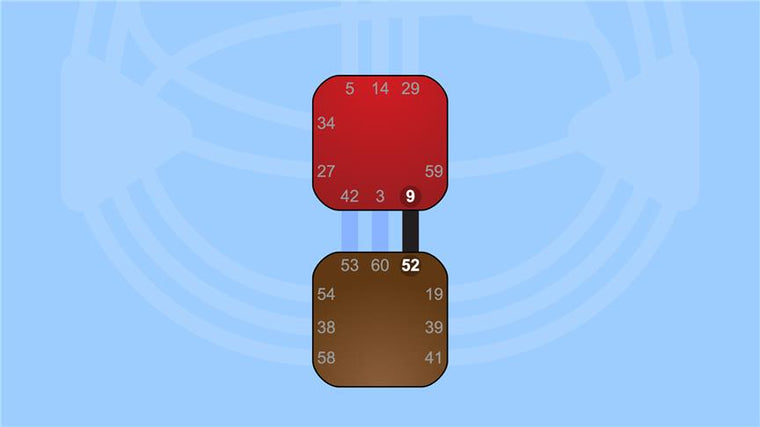
The Channel of Concentration (52-9) - Fully Unconscious (Design)
The Channel of Concentration, connecting Gate 9 in the Sacral to Gate 52 in the Root, operates in a completely different circuit: the logical understanding circuit. Where the Channel of Recognition is about feeling and imagination, this one is about focus and detail. It's the ability to hold energy still and direct it with precision toward a single process. The pressure from the Root here isn't restlessness. It's the opposite. It's a pressure to stay put, to remain focused, to gather every pertinent detail before moving.
This is the channel that explains how Jobs could obsess over the radius of a corner on an icon, the exact shade of gray on a toolbar, the specific typeface used on a circuit board nobody would ever see. That capacity to lock onto a detail and refuse to let go until it was right is Gate 9 and Gate 52 working together. The Sacral provides the sustained energy, the Root provides the pressure to keep focusing, and the result is a kind of determination that most people experience as unreasonable. Jony Ive talked about how Jobs would fixate on a single aspect of a product for weeks, examining it from every angle, insisting on one more iteration, one more refinement. The Channel of Concentration doesn't just allow that kind of attention. It demands it. The body experiences a physical need to stay still and stay focused until the pattern is perfected.
What makes these two channels remarkable when they exist in the same person is the tension between them. One channel says: feel everything, chase the next experience, dream, fantasize, be restless. The other says: sit still, focus, gather every detail, don't move until the pattern is complete. Jobs lived in that tension every day. The wild imagination and the obsessive attention to detail weren't contradictory traits that happened to coexist. They were both hardwired into his energy system, each with its own pressure from the Root Center pushing upward through different pathways. The dreaming fueled the vision. The concentration perfected the execution. When both operated in sequence, first the expansive fantasy of what could be and then the locked-in focus on making every detail right, the results were products that felt like they came from the future.

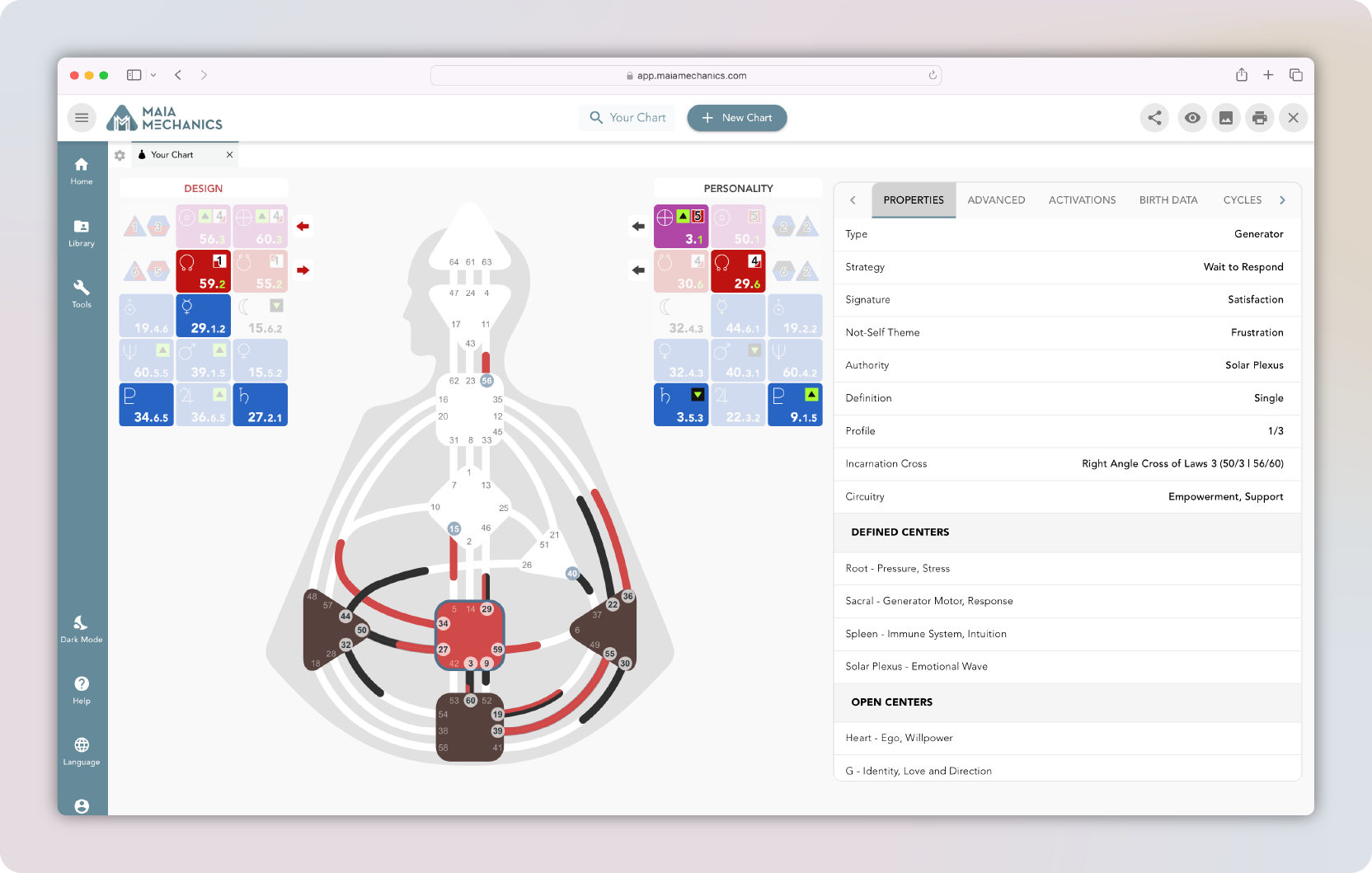
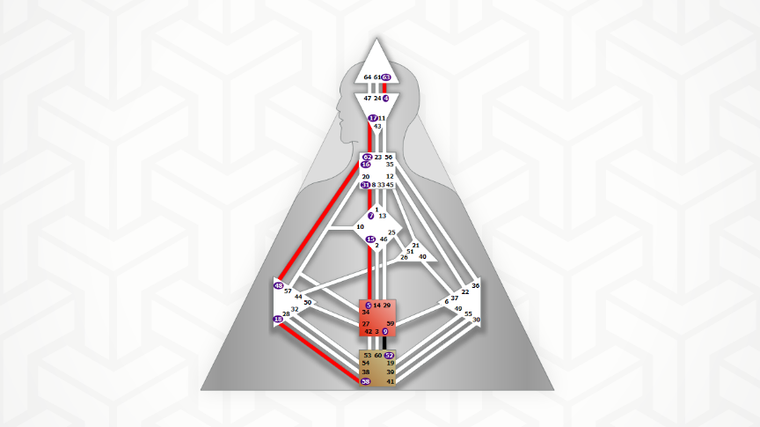
Steve Jobs had Split Definition with three defined Channels including the (41-30) Channel of Recognition, the (52-9) Channel of Concentration, and the (17-62) Channel of Acceptance.
Image Source: MaiaMechanics.com
Jobs had Split Definition, which means the defined areas in his chart were not all connected in one continuous flow. There were two separate defined groupings with a gap between them. In practical terms, this creates a particular internal experience. There's a sense that something is missing. Processing takes longer because information and energy have to move between two disconnected areas, and that integration doesn't happen instantaneously. People with Split Definition are often drawn to others who carry the gate or channel that bridges the gap between their two defined areas. When they encounter someone who bridges the split, things suddenly feel whole. There's a click. A sense of completion.
For Jobs, this shows up in his pattern with key collaborators. Steve Wozniak. Jony Ive. Tim Cook. John Lasseter at Pixar. In each case, Jobs found someone whose presence likely seemed to complete something in him. He was famously dependent on these partnerships even as he was famously difficult within them. The pull toward certain people, the almost instant recognition that this person was essential, is consistent with how Split Definition operates. The bridging energy arrives and suddenly the two parts of the self are connected. Ideas flow. Decisions integrate. Everything works better.

Together, Jobs and Wozniak formed five electromagnetic Channels, effectively bridging Jobs’ Split Definition.
The shadow side is also visible. When a key partner left or the relationship broke down, Jobs could become unmoored. His exile from Apple in 1985 wasn't just a loss of a company. It was a loss of the environment and the people who bridged his split. The years at NeXT had a searching quality to them: trying different configurations of collaborators, looking for the right people without necessarily knowing that's what he was doing. Split Definition also means that clarity takes more time. Decisions have to travel between two separate defined areas before they resolve. Combined with Emotional Authority, which already requires patience, this gave Jobs a design that needed significant time to reach good decisions. When he honored that, the results were his best work. When he didn't, forcing a decision before the split had integrated and the wave had settled, the outcomes were often the ones people point to as his mistakes.
The Channel of Acceptance (17-62) - Fully Conscious (Personality)
The Channel of Acceptance, connecting Gate 17 in the Ajna to Gate 62 in the Throat, brings us to how Jobs communicated his understanding of things. This channel is about organizing information. Seeing patterns. Understanding how parts of a structure function and where they can be improved. Backing up opinions with facts and detail. It's a logical channel, part of the same understanding circuit as the Channel of Concentration, and it gives someone a natural gift for conceptual organization.
Jobs could look at a product category (personal computers, music players, phones, tablets) and see instantly how the existing structures worked and where they fell short. He could articulate that assessment in clear, organized terms. His product presentations were marvels of conceptual organization. He would lay out the landscape of a market, identify the patterns, show where the gap was, and then present Apple's solution as the logical answer to a problem he had just made visible to everyone in the room. That's Gate 17 and Gate 62 operating together, moving from the Ajna's pattern recognition straight to the Throat's capacity for expression.
The design has a condition, though. This channel works best when the timing is right: when recognition has arrived and people are ready to hear the opinion. Without that timing, even the most accurate assessment gets dismissed, or the level of detail overwhelms the audience. Jobs learned this the hard way in his first stint at Apple. His opinions about how things should be done were often correct, but the timing was wrong. The board wasn't ready. The market wasn't ready. His colleagues weren't asking for his analysis. So his detailed, pattern-based assessments of what was broken and how to fix it felt like attacks rather than insights. By his second time at Apple, the timing had shifted. He had been recognized. People were asking. The same capacity to see patterns and organize solutions now operated with enormous impact because the invitation was there.
These four pieces worked together to produce the particular version of Steve Jobs that the world experienced: the dreaming restlessness of the Channel of Recognition, the locked-in focus of the Channel of Concentration, the internal gap of Split Definition, and the pattern-articulating power of the Channel of Acceptance.
The imagination generated the vision. The concentration perfected it. The split drove him toward the collaborators who could help him integrate it. And the organizational mind gave him the ability to present it all in a way that made sense to millions of people. Each piece had its cost. The restlessness made him hard to satisfy. The focus made him merciless about details others thought didn't matter. The split made him dependent on people he often mistreated. And the opinions, when delivered without the right timing, made him insufferable. But taken together, these mechanics explain why his particular form of intensity produced what it did.
Open Centers
So far we've looked at where Jobs had consistent, defined energy: the motors, the channels, the specific ways his life force organized itself. But a chart is equally shaped by what's open. The centers that carry no fixed energy are the places where a person takes in, amplifies, and gets conditioned by the world around them. These are the areas where the mind steps in and tries to run things, creating patterns of behavior that can look like personality but are actually responses to other people's energy. Jobs had four open centers, and taken together they explain a tremendous amount about the behaviors that weren't rooted in his own design but were absorbed from the people and environments he moved through.
Completely Open Heart Center
The most striking of these is the completely open Heart Center. This center had no activations at all. No dormant gates, nothing to provide even a framework for filtering the energy that came in. The Heart Center deals with willpower, self-worth, and the material world. When it's completely open, there's no internal reference point for what worthiness even means. The question "Am I worthy?" doesn't just produce anxiety. It produces confusion. How do you measure worth? What does it mean to prove yourself? Someone with a completely open Heart Center can't grasp these questions the way someone with even a single activation can, because there's nothing inside to hook the concept onto.
The conditioning pattern this creates is powerful. The mind says: I have to be in control. If I'm in control, I can prove my worth. I need to show them I can do this. And because there's no internal reference for what "enough" looks like, the proving never stops. Jobs was famous for this. The perfectionism, the need to control every detail, and the insistence that he personally approve decisions most CEOs would delegate all look like strength. They look like a man who knew exactly what he wanted. But from the perspective of the completely open Heart Center, what you're seeing is someone who had no consistent access to a sense of his own value and compensated by trying to demonstrate it through sheer force of will, over and over, in every product, every meeting, every interaction.
The completely open Heart Center also means not knowing what is worthy, which makes it easy to let someone else decide. This sounds contradictory for someone as controlling as Jobs, but that abdication of Authority doesn't always look passive. Sometimes it looks like letting someone else define what's worth doing and then throwing everything you have at proving you can do it. Jobs repeatedly adopted other people's frameworks for what mattered (Zen Buddhism, the counterculture, the idea that design should be the organizing principle of technology) and then committed to those frameworks with an intensity that could be mistaken for his own conviction. He made enormous promises. He told the world Apple would change everything. He told his teams they were making the best products ever created. The completely open Heart Center makes promises it can't reliably keep, because it's borrowing willpower from whatever defined energy is in the room. When Jobs was around people with strong Heart Center definition, he could summon what felt like inexhaustible will. When he was alone or the energy shifted, the foundation for those promises wasn't there in the same way.
The wisdom potential of this openness is the ability to see clearly who can actually make and keep commitments, who has genuine willpower, and who is bluffing. By the end of his life, Jobs had developed a remarkable ability to assess people's capacity, to know who could deliver and who couldn't, who had real conviction and who was performing it. That discernment is the gift the completely open Heart Center offers when the person stops trying to prove their own worth and instead observes the mechanics of worth and willpower in others.
Open Spleen Center
His open Spleen Center adds another dimension. The Spleen deals with instinct, intuition, fear, and physical wellbeing. When it's undefined, the person's sense of feeling good and feeling safe is inconsistent. It fluctuates depending on who's around. An open Spleen takes in and amplifies other people's sense of wellbeing, and their fears too. The conditioning pattern here is holding on. Holding on to people, habits, situations, and relationships that make you feel secure, even when they're not good for you, because letting go triggers a primal fear.
Jobs held on to things far longer than made sense in several areas. His initial refusal to acknowledge his daughter Lisa. His years-long loyalty to certain executives who had stopped being effective. His resistance to conventional medical treatment for his cancer, holding instead to alternative approaches that made him feel a certain way. The open Spleen doesn't have reliable in-the-moment intuition.
A person with a defined Spleen can act spontaneously and trust the hit. A person with an open Spleen who acts spontaneously is gambling. Jobs's decision to delay surgery for his pancreatic cancer in favor of dietary treatments and other alternatives is consistent with the open Spleen's pattern of chasing what feels good in the moment rather than making the harder choice that serves long-term survival. He was trying to feel better. He was trying to make the fear go away. The open Spleen's conditioning whispers: if I just find the right thing, the right diet, the right practice, I'll feel secure. But that security never stabilizes, because the center is open. It will always be inconsistent.
The wisdom of the open Spleen is the ability to diagnose. Jobs had an uncanny sense for what was healthy and unhealthy in a product, a company, an organization. He could walk into a situation and feel immediately whether it was thriving or sick. That sensitivity to wellbeing, reading the health of a system, is the open Spleen operating wisely. He applied it to products and companies with extraordinary accuracy. He applied it to his own body with much less success, because the open Spleen's conditioning around fear and security was running the show in that domain.
Open G Center
The open G Center is where identity, direction, and love live. Without definition here, there's no fixed sense of self. The identity shifts depending on the environment and the people present. Direction comes through others, through being taken along by someone else's trajectory rather than having an internal compass that always points the same way.
Jobs changed identities throughout his life. The hippie. The young tech mogul in a suit. The exile. The Zen practitioner. The turtleneck-wearing minimalist. These weren't calculated costume changes. They were the open G Center taking on the identity of whoever and whatever was most present in the environment. When he was around Zen teachers, he became the devoted student. When he was around designers, he became the design visionary. When he was around engineers, he became the demanding technologist. Each identity felt completely real to him in the moment. That's how the open G works. There's no pretense involved. The person genuinely becomes what the environment shapes them into.
The sensitivity to place is also significant. Jobs was famously particular about the physical spaces he inhabited. The design of Apple's offices, the layout of Pixar's building (which he insisted funnel everyone through a central atrium to force interaction), the way his own home was furnished (or barely furnished at all) reflected the open G Center's deep responsiveness to environment. When the place felt wrong, everything felt wrong. When the place felt right, everything clicked. His insistence on controlling the physical environment of his work was an expression of this sensitivity. He couldn't control his own sense of identity or direction internally, so he controlled the external environment that shaped those things.
The pattern of finding direction through others shows up clearly in his career. Wozniak gave him direction in the early days. The visit to Xerox PARC gave him direction. Being fired gave him direction, even if it was the direction of exile. Jony Ive's arrival gave him direction for the last fifteen years of his life. In each case, someone or something external provided the trajectory, and Jobs moved along it with the full force of his sacral energy. The open G Center's conditioning says: where do I go to find out who I am? Who can show me? Jobs answered that question again and again by finding the right people and places, then pouring himself into whatever identity and direction emerged from the encounter.
Open Head Center
Finally, the open Head Center. This is where mental pressure, inspiration, doubt, and confusion operate. With an open Head Center, the mind is perpetually available to be filled by whatever questions and inspirations are in the environment. The person can become fascinated by almost anything. They can also become overwhelmed by questions that have nothing to do with them, spending energy trying to resolve doubts that belong to someone else entirely.
Jobs was a voracious consumer of ideas. Calligraphy classes. Eastern philosophy. Industrial design history. Music. Nutrition. Architecture. The open Head Center takes in inspiration from everywhere and amplifies it. Each new source of fascination feels urgent, important, worth pursuing. The positive expression of this is the ability to draw from an extraordinarily wide range of intellectual and aesthetic sources and bring them together in unexpected ways. Jobs's famous ability to connect things that seemed unrelated was the open Head Center at its best: calligraphy and computer typography, Zen minimalism and consumer electronics, the Bauhaus tradition and mass-market products. He could take in inspiration from any domain because he wasn't locked into any single way of thinking.
The shadow side is the pressure to resolve questions that aren't yours. Jobs often took on the mental burdens of everyone around him. He would become consumed by a problem that had been presented to him by someone else and refuse to rest until he had solved it, even when it wasn't his to solve. The open Head Center's not-self pattern says: I've got to understand this. I've got to make sense of this. Where do I go to find the answers? That relentless drive to resolve, to know, to have the answer fueled his reputation as someone who always had a point of view on everything. But a significant portion of that mental activity was conditioned. It was other people's questions, amplified and processed through his open Head Center, coming back out as what appeared to be his own conviction.
Bringing It All Together
Taken together, these four open centers (completely open Heart, open Spleen, open G, and open Head) create a picture of someone who was very absorptive. Jobs took in the worthiness drives of everyone around him and amplified them into a compulsive need to prove himself through his work. He took in the fears and health concerns of others and amplified them into both a heightened diagnostic ability and a vulnerability around his own physical wellbeing. He took in the identities and directions of the people and places he encountered and amplified them into a shape-shifting quality that could look like genius or like instability depending on the context. And he took in the mental pressures and inspirations of everyone in his aura and amplified them into a mind that seemed to be thinking about everything all the time.
The defined parts of Jobs's chart (the sacral motor, the emotional wave, the channels of concentration and recognition and acceptance) provided the engine and the specific capacities. But the open centers provided the windows into the outer world. They made him a receptor for the world's energy, constantly taking in and magnifying what was around him. The products he created were, in a real sense, reflections of this absorption. He didn't invent from a vacuum. He absorbed ideas, aesthetics, fears, desires, and identities, and then processed all of it through his defined channels, which gave it focus, emotional charge, and conceptual structure. What came out the other end was something that felt like it understood people, because it had literally been shaped by taking people in.
The cost was high. Four open centers means four places where the mind can hijack decision-making. Four places where conditioning runs deep. Four places where the not-self patterns are persistent and persuasive. The drive to prove worth. The fear of letting go. The search for identity. The pressure to answer every question. These patterns were visible in Jobs throughout his life, and they explain much of the difficulty people experienced in working with him. The openness that made him so receptive to the world's input also made him vulnerable to the world's conditioning. The genius and the difficulty came from the same source.
Continue to Part 3: Steve Jobs' Incarnation Cross

Ryan Hanna


























Teachings by Topic
Type & Strategy
Explore Ra Uru Hu's lectures by Human Design topic.

Basics for Beginners
Sale price$10.00
Are you new to Human Design, or looking for a solid understanding of the BodyGraph, its mechanics, and an overview of the Types and major Inner Authorities? This 1-hour introduction to the basics of Human De...
Generator and Manifesting Generator
Sale price$9.00
The type that is essential to the well-being of our species as a whole is the Generator, who represent around 70% of the human population (Half of which are pure Generators, the other half are Manifesting Ge...
The Way of the Generator
Sale price$57.00
Living our Design involves setting the mind and its Not-Self urgings aside, and relying instead on Strategy and Authority. It’s a process of learning to “surrender to the experiment”, as Ra puts it. That sur...

Fallen Angels
Sale price$9.00
The way of the Generator is everybody's way in the homogenized world while the planet is run by and dominated by the frustrated, enslaved spirit of Generators.
In order for Generators to be able to live acco...
Frustration or Satisfaction | RC8.10
Sale price$19.00
Generators represent almost 70% of the world’s population. As a vital source of productive energy, they generally have a great impact on everyone around them, making their awareness and well-being important ...
The Art of Reading Generators
Sale price$57.00
If you are interested in understanding Generators, either because you are one yourself or you want to learn about the dominant Type on this planet, this package is an excellent learning opportunity. The Art ...
Sex and the Generator
Sale price$19.00
The nature of sexuality varies greatly among the different Types. And the primary difference stems from the Sacral Center itself, which is the core and essence of what a Generator is.
Through response, the n...
Generator Transformation - The Color of Envelopment
Sale price$19.00
A detailed guide to the Generator aura and its unique relationship to each Type, this lecture explores the theme of conditioning through Color Transference and how varied this phenomenon is for Generators—of...
Projector
Sale price$9.00
Projectors are a non-energy Type and represent just over 20% of the population. As a relatively new form, they are only now beginning to come into their natural power and position. Join Ra as he discusses ho...
Projectors - A Clarion's Alert
Sale price$9.00
Projectors, your focused and penetrating aura is needed through invitation to take in knowledge bases and master the systems that organize and hold humanity together. You are needed as an enormous resource f...
The Art of Reading Projectors
Sale price$57.00
The Art of Reading Projectors is an invaluable audio experience for anyone wanting deeper insight into the Projector Aura Type. Ra takes us through six overviews of unique Projectors, each approximately 30 m...

Projector Empowerment 1 | Lectures
Sale price$47.00
Projectors have the potential to make tremendous contributions to those in their lives. By Design, Projectors are about the other. The insight and guidance they bring to others when they are in alignment wit...

Projector Empowerment 2 | Analysis
Sale price$67.00
Acknowledging how each Projector offers their unique guidance to the world can help empower their signature of success.
Projector Empowerment | Part II: Analysis focuses on Ra’s examination of individual Pro...
Projector Transformation - Color Transference Recognition
Sale price$19.00
This lecture dives into substructure, offering the practical value of understanding Personality Motivation and Perspective to Projector success. As the youngest Type historically, Projectors are on the rise,...
Manifestor
Sale price$9.00
Only about 9% of the population are Manifestors. As we move towards 2027, statistically there will be a real burst in the number of their births. This theme of the Manifestor and particularly how to raise Ma...

Manifestor Manifesto
Sale price$67.00
Do you remember the song, “It’s Not Easy Being Green”? The same could be said of the challenges of being a Manifestor. Manifestors currently account for 9% of the population — a small percentage, but with qu...
Manifestor Manifesto (eBook)
Sale price$49.00
This guide for Manifestors came out of a five-week program in which Ra informed Manifestors how to transform their lives and fully embrace their manifesting potential and gifts. Although this material was ex...
Manifestor Encore
Sale price$9.00
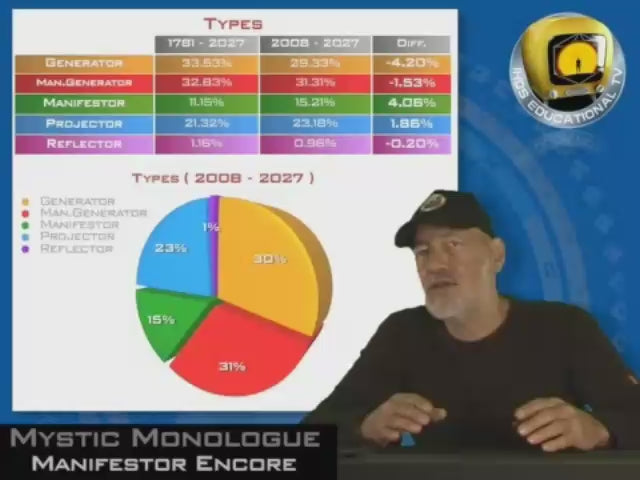
We are living in a time of transition, a time of change, a time of deep mutation. Everything about the nature of the world we live in, in a sense, can be understood from the current background frequency.
The...
Manifestor Transformation - Motivation and Impact
Sale price$19.00
This is a deeper exploration of the Manifestor process through aura and Color, and a guide to correctness for Manifestors and those who are impacted by them.
Historically, Manifestors were the alphas of huma...
Reflector
Sale price$9.00
Reflectors represent around 1.3 or 1.4% of the human population, and as such are very different from the other Types.
A Reflector’s design is unique in that there is no definition in the Bodygraph, and there...
Reflector Reflections
Sale price$19.00
This is a practical guide to understanding the Reflector process and purpose along with new tools for aiding them in their experiment.
Reflectors are the rarest Type on the planet. WIthout any definition in ...
The Signature Question
Sale price$9.00
Signposts are something that allow you to have a way for your mind to measure. Signature is the positive side of the not-self theme of any Type. In The Signature Question, Ra explains the signposts for each ...

The Type Series: Strategy, Signature and Aura
Sale price$22.00
Regular price$36.00
Everyone has the potential for differentiation in this life.
What is actualized through Type—Generator (and Manifesting Generator), Manifestor, Projector, Reflector—is an extraordinary potential inherent in ...

Type Sexual Signatures
Sale price$19.00
We all have the potential for sexual fulfillment. However, most human beings don't enter into bonds correctly. With most of the population being made up of Generators, this leaves much of the world giving of...

You and the Other
Sale price$19.00
Type is one of the most influential aspects of the connection between two people. The inherent aura mechanics of each person in a partnership determine how each can relate to the other — or how the relations...

A Human Design Guide to Parenting
Sale price$19.00
Raising children can be challenging in many ways. Knowing what to do and how to approach them based on their uniqueness takes awareness of specific techniques that parents are often not equipped with.
Human ...

Raising Children According to Their Design
Sale price$17.00
For many of us, learning to live according to our Design is eye-opening. So many things change and make sense when our approaches and choices are informed by our unique Design. As we recognize more and more ...
Nurturing a Unique Being
Sale price$29.00
There are many perspectives on how children should be raised. How do we know which ones are best?
Everything from what to eat, how to create bedtime habits, and the best methods to educate are often taught i...

Design Concepts
Sale price$97.00
The Maia? The Monopole? And what is the G Center?
If you’re looking for an in-depth introductory teaching to Human Design, the 10-lesson Design Concepts course is a valuable guide to the foundational element...

Design Concepts (eBook)
Sale price$49.00
If you’re new to Human Design, this ebook will greatly expand your understanding of Human Design fundamentals. Taught by Ra Uru Hu, Design Concepts is an ideal opportunity for Human Design students and newco...

The Four Views
Sale price$99.00
Do you want to learn more about Human Design but don’t know where to begin? Knowing how to look at the BodyGraph is key to understanding foundational concepts to start your own experiment.
After years of tea...

The Four Views (eBook)
Sale price$49.00
Do you want to learn more about Human Design but don’t know where to begin? Knowing how to look at the BodyGraph is key to understanding foundational concepts to start your own experiment.
After years of tea...
Keynoting
Sale price$29.00
Looking at a Human Design chart can be overwhelming. There is simply so much information available. Some people see the Gates first, others the Channels, and some the Centers. But, what is the "correct" meth...
The History of the Types - An Evolutionary View | RA 2.10
Sale price$19.00
In 1994, Ra Uru Hu published a collection of graphics and keynotes he called “Rave Anatomy: Mapping the Mechanics of the Maia.” In 2007, he updated those graphics and recorded Rave Anatomy 1. The following y...

Beginner 1: Fundamentals of the Human Design System
Sale price$249.00
Regular price$411.00
Beginner 1 is your gateway into the original teachings of Ra Uru Hu. This immersive course delivers a carefully curated learning experience designed to ground you in the essential mechanics, language, and co...

Beginner 2: Type, Strategy, and Inner Authority
Sale price$249.00
Regular price$426.00
This course offers a clear and practical introduction to the four Human Design Types and the vital role of Strategy and Inner Authority. Through a curated series of Ra Uru Hu’s most accessible teachings, you...

Your Own Authority - A Beginner's Guide to Human Design
Sale price$22.00
Your Own Authority – A Beginner’s Guide to Human Design by Dharmen and Leela Swann Herbert - e-Book with full-color illustrations, 138 pages.
This beginner’s guide is a general introduction to the Human Desi...

Intermediate 3: Relationships, Sex, and Family
Sale price$349.00
Regular price$589.00
Relationships are one of the most powerful mirrors for awakening—and one of the most complex arenas of conditioning. In this course, Ra Uru Hu explores how Human Design reveals the true mechanics of how we b...
Ra's Guide to the Rave Chart
Sale price$29.00
Human Design BodyGraphs display an intricate synthesis of 26 activations across 9 Centers and 64 Gates. Is there a simple way to extract and benefit from the information being displayed without needing to kn...

Ra's Guide to the Movie
Sale price$39.00
Behind its practical aspects, Human Design has roots in deeply mystical concepts. When one is beginning to investigate those deeper aspects of the knowledge, one needs to study the foundational concepts to s...

The Ra Uru Hu Lectures | Ibiza 2009
Sale price$57.00
Regular price$76.00
This 4-part video collection explores how we navigate the changing mechanics of life and consciousness—uncovering the impact of shifting financial structures, the role of the Moon in shaping our experiences,...

The Just About You Series
Sale price$117.00
Regular price$172.00
The Just About You series brings together six essential lectures that explore the many ways Human Design shapes our lives and relationships. From uncovering the wisdom hidden in our shadows and understanding...

The Mystic Monologues Series
Sale price$77.00
Regular price$108.00
The Mystic Monologues invites you into the extraordinary journey of Ra Uru Hu, a skeptic turned mystic, whose life was transformed by a profound encounter with “The Voice” on January 3, 1987. This series of ...
Teachings by Theme
Decision-Making
Explore Ra Uru Hu's lectures categorized into life themes and goals.
Basics for Beginners
Sale price$10.00
Are you new to Human Design, or looking for a solid understanding of the BodyGraph, its mechanics, and an overview of the Types and major Inner Authorities? This 1-hour introduction to the basics of Human De...
Your Own Authority - A Beginner's Guide to Human Design
Sale price$22.00
Your Own Authority – A Beginner’s Guide to Human Design by Dharmen and Leela Swann Herbert - e-Book with full-color illustrations, 138 pages.
This beginner’s guide is a general introduction to the Human Desi...
Generator and Manifesting Generator
Sale price$9.00
The type that is essential to the well-being of our species as a whole is the Generator, who represent around 70% of the human population (Half of which are pure Generators, the other half are Manifesting Ge...
The Way of the Generator
Sale price$57.00
Living our Design involves setting the mind and its Not-Self urgings aside, and relying instead on Strategy and Authority. It’s a process of learning to “surrender to the experiment”, as Ra puts it. That sur...
Fallen Angels
Sale price$9.00
The way of the Generator is everybody's way in the homogenized world while the planet is run by and dominated by the frustrated, enslaved spirit of Generators.
In order for Generators to be able to live acco...
Frustration or Satisfaction | RC8.10
Sale price$19.00
Generators represent almost 70% of the world’s population. As a vital source of productive energy, they generally have a great impact on everyone around them, making their awareness and well-being important ...
Generator Transformation - The Color of Envelopment
Sale price$19.00
A detailed guide to the Generator aura and its unique relationship to each Type, this lecture explores the theme of conditioning through Color Transference and how varied this phenomenon is for Generators—of...
Projector
Sale price$9.00
Projectors are a non-energy Type and represent just over 20% of the population. As a relatively new form, they are only now beginning to come into their natural power and position. Join Ra as he discusses ho...
Projectors - A Clarion's Alert
Sale price$9.00
Projectors, your focused and penetrating aura is needed through invitation to take in knowledge bases and master the systems that organize and hold humanity together. You are needed as an enormous resource f...
Projector Transformation - Color Transference Recognition
Sale price$19.00
This lecture dives into substructure, offering the practical value of understanding Personality Motivation and Perspective to Projector success. As the youngest Type historically, Projectors are on the rise,...
Manifestor
Sale price$9.00
Only about 9% of the population are Manifestors. As we move towards 2027, statistically there will be a real burst in the number of their births. This theme of the Manifestor and particularly how to raise Ma...
Manifestor Manifesto
Sale price$67.00
Do you remember the song, “It’s Not Easy Being Green”? The same could be said of the challenges of being a Manifestor. Manifestors currently account for 9% of the population — a small percentage, but with qu...
Manifestor Manifesto (eBook)
Sale price$49.00
This guide for Manifestors came out of a five-week program in which Ra informed Manifestors how to transform their lives and fully embrace their manifesting potential and gifts. Although this material was ex...
Manifestor Encore
Sale price$9.00
We are living in a time of transition, a time of change, a time of deep mutation. Everything about the nature of the world we live in, in a sense, can be understood from the current background frequency.
The...
Manifestor Transformation - Motivation and Impact
Sale price$19.00
This is a deeper exploration of the Manifestor process through aura and Color, and a guide to correctness for Manifestors and those who are impacted by them.
Historically, Manifestors were the alphas of huma...
Reflector
Sale price$9.00
Reflectors represent around 1.3 or 1.4% of the human population, and as such are very different from the other Types.
A Reflector’s design is unique in that there is no definition in the Bodygraph, and there...
Reflector Reflections
Sale price$19.00
This is a practical guide to understanding the Reflector process and purpose along with new tools for aiding them in their experiment.
Reflectors are the rarest Type on the planet. WIthout any definition in ...
The Signature Question
Sale price$9.00
Signposts are something that allow you to have a way for your mind to measure. Signature is the positive side of the not-self theme of any Type. In The Signature Question, Ra explains the signposts for each ...
The Type Series: Strategy, Signature and Aura
Sale price$22.00
Regular price$36.00
Everyone has the potential for differentiation in this life.
What is actualized through Type—Generator (and Manifesting Generator), Manifestor, Projector, Reflector—is an extraordinary potential inherent in ...
Projector Empowerment 1 | Lectures
Sale price$47.00
Projectors have the potential to make tremendous contributions to those in their lives. By Design, Projectors are about the other. The insight and guidance they bring to others when they are in alignment wit...
Projector Empowerment 2 | Analysis
Sale price$67.00
Acknowledging how each Projector offers their unique guidance to the world can help empower their signature of success.
Projector Empowerment | Part II: Analysis focuses on Ra’s examination of individual Pro...
Solar Plexus Inner Authority
Sale price$9.00
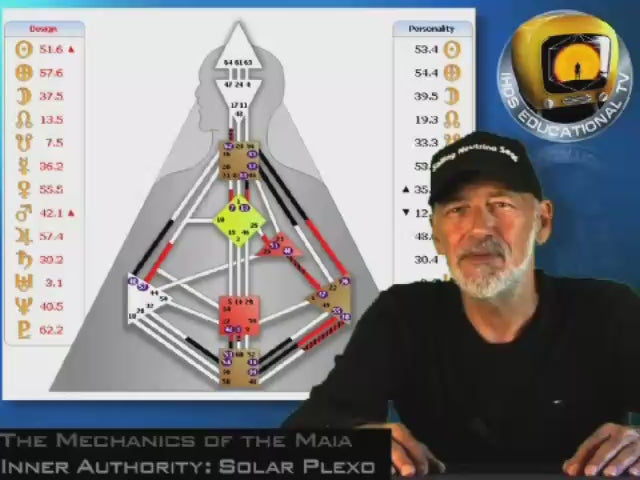
If you have a defined Solar Plexus Center, this is automatically your decision making authority. It is the most common of all inner authorities, belonging to about 51% of humanity.
The Solar Plexus center op...
Sacral Inner Authority
Sale price$9.00
Sacral Authority belongs to non-emotional Generators, including Manifesting Generators, who have an undefined Solar Plexus Center. Correct Sacral Authority responds existentially, in each moment, to what li...
Splenic Inner Authority
Sale price$9.00
In order to have Splenic authority, you cannot have a defined Solar Plexus or Sacral Center but must have a defined Splenic Center.
Splenic authority operates only in the Now. It is not a motor and can be d...
Minor Authorities
Sale price$9.00
Ra looks at a group of rare authorities that represent about 4% of people. They can be quickly recognized as designs with at least one defined channel and an open Solar Plexus Center, an open Sacral Center a...
No Direct Inner Authority
Sale price$9.00
Definition is what leads us to see both Type and where the decision making Authority lies. In this lecture, Ra takes us through the two very different variations of those who have no direct inner authority: ...

The Inner Authority Series
Sale price$27.00
Regular price$45.00
Inner Authority is a transformative series where Ra Uru Hu guides you through the core mechanics of decision-making within the Human Design System. This series provides a comprehensive understanding of Inner...
Outer Authority - The Truth About Mind
Sale price$19.00
How much do you trust your mind when making decisions? Human Design states that giving the Mind this authority frequently leads to resistance and getting stuck in the themes of our open centers.
When using S...
The Just About You Series
Sale price$117.00
Regular price$172.00
The Just About You series brings together six essential lectures that explore the many ways Human Design shapes our lives and relationships. From uncovering the wisdom hidden in our shadows and understanding...
Design Concepts
Sale price$97.00
The Maia? The Monopole? And what is the G Center?
If you’re looking for an in-depth introductory teaching to Human Design, the 10-lesson Design Concepts course is a valuable guide to the foundational element...
Design Concepts (eBook)
Sale price$49.00
If you’re new to Human Design, this ebook will greatly expand your understanding of Human Design fundamentals. Taught by Ra Uru Hu, Design Concepts is an ideal opportunity for Human Design students and newco...
The Four Views
Sale price$99.00
Do you want to learn more about Human Design but don’t know where to begin? Knowing how to look at the BodyGraph is key to understanding foundational concepts to start your own experiment.
After years of tea...
The Four Views (eBook)
Sale price$49.00
Do you want to learn more about Human Design but don’t know where to begin? Knowing how to look at the BodyGraph is key to understanding foundational concepts to start your own experiment.
After years of tea...

The Human Design System: A Complete Guide Series
Sale price$197.00
Regular price$285.00
In this multi-lesson video series Ra Uru Hu offers a profound and comprehensive journey through the full architecture of Human Design. Spanning topics from the origin of consciousness and the mechanics of th...
Beginner 1: Fundamentals of the Human Design System
Sale price$249.00
Regular price$411.00
Beginner 1 is your gateway into the original teachings of Ra Uru Hu. This immersive course delivers a carefully curated learning experience designed to ground you in the essential mechanics, language, and co...
Beginner 2: Type, Strategy, and Inner Authority
Sale price$249.00
Regular price$426.00
This course offers a clear and practical introduction to the four Human Design Types and the vital role of Strategy and Inner Authority. Through a curated series of Ra Uru Hu’s most accessible teachings, you...

Beginner 3: The Not-Self and Conditioned Mind
Sale price$199.00
Regular price$307.00
Beginner 3 offers an essential introduction to one of the most transformative teachings in Human Design: the Not-Self. Through Ra Uru Hu’s foundational lectures and in-depth analysis, you’ll explore how ment...
The Mystic Monologues Series
Sale price$77.00
Regular price$108.00
The Mystic Monologues invites you into the extraordinary journey of Ra Uru Hu, a skeptic turned mystic, whose life was transformed by a profound encounter with “The Voice” on January 3, 1987. This series of ...